Walking new pathways – women volunteers in emergency services
By Celeste Young, Collaborative Research Fellow and Sub Discipline Co-Lead Systemic Risk, Disaster & Resilience, Victoria University
If volunteers are the backbone of the emergency management agencies, then the women who enable and participate in it could be seen as its heart.
Women have always played an important role in emergency services volunteering. They have contributed thousands of hours protecting and supporting their communities through emergencies, bushfires, storms, heatwaves and floods. These volunteers occupy a unique position as they are not paid, choosing to give their time freely. Their roles are diverse and include leadership, specialisation, interpreters, catering, logistics, education, front line response, communication, professional services and support of others to volunteer. These volunteers exist in an ecosystem which spans community, businesses, government and emergency management agencies and networks. But their contributions are not always seen or valued. Patchy data does little to assist understanding as to who these volunteers are and the important role women play.
In the past, women volunteers were often restricted to support or administrative duties rather than response activities. Informally, women have always helped sustain male-dominated response, through provisioning, logistical support and keeping things going at home, invisible, but vital roles. However, drivers such as changing social norms, new expectations of work and workplaces and the increasing frequency and intensity of natural hazard events are creating pressures points for the sector, which provide both challenges and opportunities for women. It is challenging emergency management organisations to rethink traditional notions of what emergency management volunteers are, who should and can volunteer and how they might volunteer.
The last decade has seen considerable change in not only the physical environment in which EM volunteers operate, but also in how communities and individuals choose to live and work.
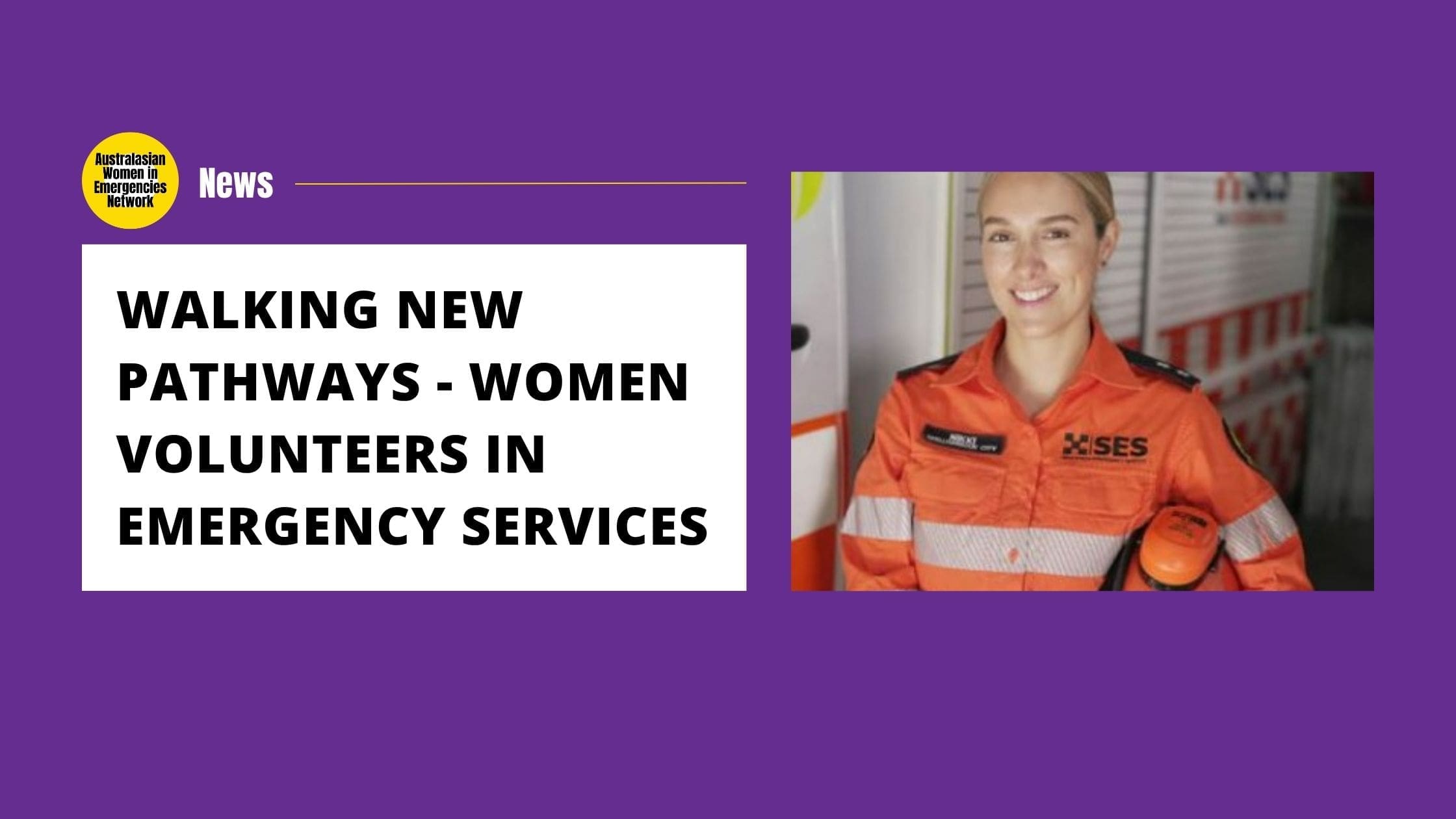
These changes are starting to manifest across the emergency management volunteering sector. There is now a dialogue around providing a safe space for diverse cohorts and regulations related to psychological safety. There are established inclusion policies and programs such as Girls on Fire, Women in Rescue and Champions of Change Emergency Services. There have also been increases of women in front line and leadership roles, particularly in State Emergency Services. One example of this is in in the Pilbara in Western Australia where women make up 43 per cent of crews in Exmouth and 40 per cent in Port Hedland DFES Marine Rescue crews. Women are becoming more visible and are starting to walk new pathways.
Even with this progress, attracting and maintaining formal volunteers, particularly women in the fire services in regional, rural and remote areas, remains a considerable challenge for the emergency management sector. The heightened demands on emergency services organisations and communities due to the changing nature of natural hazard events is adding additional pressure. There is now a broad recognition of the need for emergency management volunteering organisations to evolve and innovate, if they are to be sustainable into the future. Building the flexible systems and the inclusive cultures needed to enable greater participation of women and diverse cohorts is central to this.
Building strength, capability and skills
The role of women in communities, and how they can and want to volunteer, are closely connected. This means that for organisations to build the environments they need to attract and maintain volunteers, they first need to understand the specific capabilities of women in different communities. Our post Black Summer Assessment of East Gippsland communities in 2021 found that women leaders were a strength in that region. The Lake Tyres Aboriginal Trust station an all-female First Nations CFA brigade established in the early 2000s is an example. Identifying and building on strengths and developing community skills can help build risk literacy more broadly across communities which can support surge needs.
As women as a cohort are diverse, there is a need to better understand how to remove barriers to participation such as cost, time constraints, cultural expectations and discrimination. It is also important to recognise and make visible the formal and informal ways that women do and can contribute to volunteering as front line and supporting roles are both vital. These aspects are nuanced and can vary from community to community.
With the expansion of the volunteering role beyond response (Figure1), new skills, particularly people-based skills and ways of working are required. These have traditionally been seen as less than important than the technical skills response focused skills and are often associated with women’s roles. Rewarding and valuing these skills and capabilities is central to maintaining those who have them and making visible the value that they bring into organisation. There is also an opportunity to develop career pathways and curate female leadership as this can incentivise participation of younger people and those returning to the workforce.

FIGURE 1: OVERVIEW OF THE EXPANSION OF PPRR PHASES BY VOLUNTEERS AND THEIR EMO (NSW GOV, 2024, p5)
A fundamental shift more generally in volunteering preferences from longer-term to shorter-term commitments. Integration of more informal volunteering models such as spontaneous volunteering and flexible arrangements can create new opportunities for women to participate in the time they have available.
Innovating for a dynamic future
We live in a dynamic world where technological and social innovation are fundamentally shifting how we live, work and think about ourselves and the roles we as women play. Emergency Management organisations have an opportunity to lean into this and capitalise on the opportunities it offers to diversify and grow its volunteering base. However, to do this effectively, organisations across the sector and government will need to work hand in hand with their communities and listen to the voices within them. This will require proactive and inclusive leadership to create and maintain the environments needed where difference is welcomed, and women and diverse cohorts feel they belong, and are appreciated for what they bring to the table. It will also require social innovation to build new systems and ways of working that enable rather than disable women. But most importantly it will require ongoing investment and resourcing.
Progress in the women in emergency services agenda is hard won, as resistance to change and backlashes are part of the process. It has never been more important to hold the line and to support women volunteers and celebrate their achievements. Their participation and representation is no longer just about ensuring equality, it is now central to future emergency management capability and sustainability.
Bibliography
McLennan, B. J., Chong, J. X. Y., and Dunlop, P. D. (2022). Emergency Services Workforce 2030. RMIT University, Curtin University, BNHCRC, Melbourne.
NSW Government. (2024). Review of Emergency Management Volunteering, Report 1: The Current State of Emergency Volunteering. Premier’s Department, Sydney.
Young, C., Jones, R. N., Parry, N., Ooi, D and Dadswell, K. (2025). The Emergency Management Sustainable Volunteering Blueprint: Strategic Framework. Natural Hazards Research Australia.
Young, C., and Jones, R. N. (2019). Effective diversity in emergency management organisations: the long road. Australian Journal of Emergency Management, 34(2), 38-45.
Young, C., Jones, R. N., and Cormick, C. (2021). Growing the Seeds: Recovery, Strength, and Capability in Gippsland Communities. Victoria University, Melbourne